

『Principle of electromagnetic flowmeter』Related information(clamp on meter|electromagnetic meter|venturi meterrotameter|orifice meter|ultrasonic flow meter|mass flow meter|coriolis mass flow meter|coriolis flow meter|magnetic flow meter|magmeter flow meter|magflow flow meter|mag meter flow meter|electromagnetic flow meter|vortex flow meter|turbine flow meter|thermal mass flow meter|thermal flow meter|rotameter flow meter)

What is the principle of electromagnetic flowmeter?
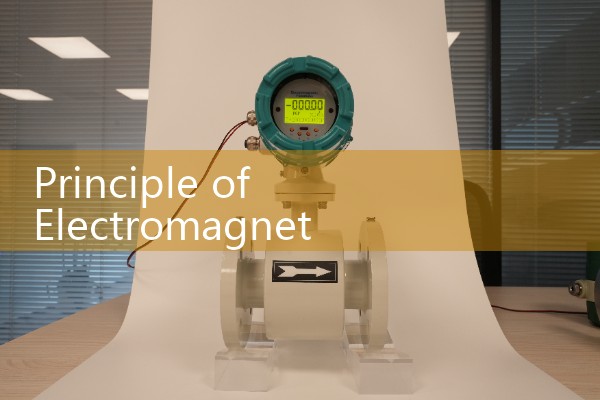
The electromagnetic flowmeter works based on Faradays law of electromagnetic induction, and its core principle is to calculate the flow rate by measuring the induced voltage generated by cutting magnetic lines in a conductive medium.. The specific process is as follows:
1. Magnetic field generation and induced voltage generation. The measuring tube is equipped with an excitation coil, which generates a constant magnetic field perpendicular to the pipeline axis (magnetic flux density B) after being energized. When a conductive medium (such as a liquid) flows through a pipeline, its direction of motion is perpendicular to the direction of the magnetic field, which is equivalent to the conductor cutting magnetic field lines. According to Faradays law of electromagnetic induction, an electromotive force E is induced in a conductive medium, which is proportional to the magnetic flux density B, the inner diameter profile d of the measuring tube, and the average fluid velocity v. The formula is: E=K × B × d × v, where K is the instrument constant determined by the electrode spacing and pipeline structure. Two electrodes are symmetrically installed on the inner wall of the measuring tube for signal detection and transmission to detect the induced electromotive force E. Due to the direct contact between the electrodes and the fluid, and the use of non-conductive lining materials (such as rubber and Teflon) in the measuring tube, electromagnetic isolation is achieved, avoiding corrosion of the electrodes by the fluid while ensuring signal accuracy. The detected voltage signal is transmitted to the converter through a cable. The signal processing and output
5. Bidirectional measurement and stability electromagnetic flow meters can distinguish between forward and reverse fluid flow, and achieve flow accumulation through a bidirectional measurement system. Its sensor only comes into contact with the measured liquid, and with high-quality materials and special processes, ensures long-term stability, small zero drift, and measurement accuracy is not affected by changes in fluid density, temperature, and pressure.
2. Working principle of electromagnetic flowmeter
Working principle of elect
 Hot Blog
 Related AD