

『Jatropha Oil Flow Meter Biofuel Plant Intake Layouts』Related information(clamp on meter|electromagnetic meter|venturi meterrotameter|orifice meter|ultrasonic flow meter|mass flow meter|coriolis mass flow meter|coriolis flow meter|magnetic flow meter|magmeter flow meter|magflow flow meter|mag meter flow meter|electromagnetic flow meter|vortex flow meter|turbine flow meter|thermal mass flow meter|thermal flow meter|rotameter flow meter)
Jatropha Oil Flow Meter for Biofuel Plant Intake Layouts
Quick Answer: For jatropha oil intake lines in biofuel plants, choose a Coriolis mass flow meter or an oval gear positive displacement flow meter. Coriolis meters measure mass flow directly, ignore viscosity changes, and deliver 0.2% accuracy. Oval gear meters are simpler and cost less for clean, heated oil with viscosities from 5 to 2000 cP. Electromagnetic flow meters will not work because jatropha oil does not conduct electricity.
Here is the thing, jatropha crude oil is not like diesel or palm oil. Its viscosity swings sharply with temperature. A batch from the screw press might leave at 40 °C and 60 cP. If you let it cool to 25 °C in the storage tank, viscosity can climb above 100 cP. When the plant heats the oil to 60 °C for transesterification, the viscosity drops to around 30 cP. Many engineers skip this detail and then wonder why their volumetric meter readings drift by 5 % from morning to afternoon.
We have seen this on customer sites many times. Last year a biofuel producer in Sumbawa, Indonesia, installed a turbine flow meter on a DN25 jatropha feed line. The wax content and fine solids clogged the bearing after three weeks. They replaced it with a Silver Automation Instruments oval gear flow meter, model SIOG-025, and added a 100-micron Y-strainer upstream. The meter has been running for 14 months without any blockage. They now log flow totals with a paperless recorder connected to the 4-20 mA pulse output.
Which Flow Meter Technologies Fit Jatropha Oil
Coriolis mass flow meters are the top choice when you need mass balance for the reactor. A Silver Automation Instruments SICM series Coriolis meter with DN15 to DN50 flanges reads mass flow in kg/h, density, and temperature. It sends 4-20 mA HART signals directly to the PLC. Because Coriolis meters measure mass, you do not need to compensate for density changes. This is valuable when your raw jatropha oil source varies between first-press and solvent-extracted batches. You can order the meter with ATEX Zone 1 certification if the plant handles hexane vapors near the extraction unit.
Oval gear positive displacement meters are the cost-effective alternative for volumes under 5000 kg/h. Silver Automation Instruments supplies the SIOG series from DN10 to DN50, with aluminium or stainless steel housings. These meters work well with heated oil kept at a stable temperature, say 60 °C +/-3 °C. They deliver pulse and 4-20 mA outputs. Make sure to install a mesh strainer right before the meter because jatropha press cake can carry small fibers. Without the strainer, fibers will jam the oval gears. In practice, clean the strainer every two weeks during normal operation.
Do not use electromagnetic flow meters for jatropha oil. The oil is a hydrocarbon with very low electrical conductivity, typically below 1 µS/cm. The magmeter will show zero flow or erratic readings. Ultrasonic clamp-on meters can measure clean, degassed jatropha oil on larger pipes, but high viscosity damps the acoustic signal. If the oil temperature is below 40 °C, the clamp-on meter may lose signal completely. Our support team rarely recommends ultrasonic for raw vegetable oil intake lines. Stick to inline Coriolis or oval gear.
Typical Intake Layout from Storage to Reactor
A reliable intake layout for a jatropha oil line starts with a crude oil storage tank, often a 20 m3 cone-bottom tank with heating coils. A positive displacement pump pushes the oil through a 100-micron Y-strainer. Af
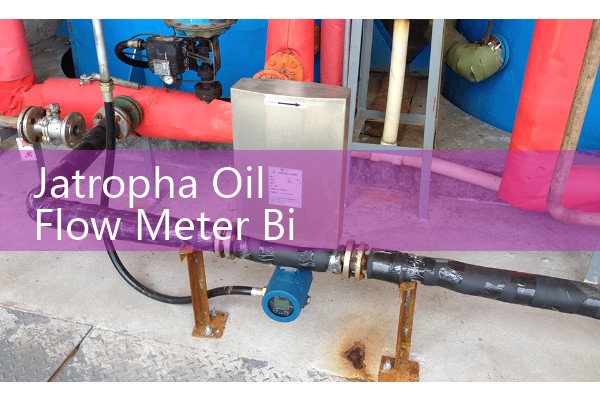
The flow meter sits downstream of the heater, in a horizontal pipe section. For oval gear meters, mount the meter with the gears in a vertical plane to let any small particles sink. Keep a straight pipe run of 10 pipe diameters upstream and 5 diameters downstream if the meter manual allows; this is more critical for vortex meters which we do not use for high-viscosity oil. Install a bypass line around the flow meter with isolation valves. During maintenance, you can open the bypass and keep the reactor feed running. After the flow meter, a pneumatic control valve modulates the flow based on a 4-20 mA signal from the DCS. Some plants also place a second pressure transmitter downstream of the control valve to check pressure drop across the meter.
Air pockets cause the biggest headaches in oil flow measurement. Vent the system through a high-point bleed valve before startup. Fill the line slowly with oil to push out air. Never locate the flow meter at the highest point of the pipe. A horizontal installation with the pipe always full of oil guarantees stable readings. We saw a plant in Mozambique that installed an oval gear meter on a vertical downpipe, and the meter lost prime every morning. After they moved it to a horizontal section, the issue disappeared.
FAQ About Jatropha Oil Flow Meters
Can I measure jatropha oil with a turbine meter? We do not recommend turbine meters for raw vegetable oils. Jatropha oil contains wax, phospholipids, and small fibers that foul ball bearings. The meter will require frequent cleaning and calibration. Positive displacement or Coriolis meters handle dirty liquids much better.
What pipe size do I need for a 2000 kg/h flow of jatropha oil? For a density of about 920 kg/m3 and a flow velocity of 0.5 to 2 m/s, a DN25 or DN40 line works. A DN25 oval gear meter covers up to 3000 kg/h. Select a DN15 meter for pilot plants below 500 kg/h.
Do I need ATEX certification? If the meter is near a solvent extraction unit using hexane, yes, Zone 1 or Zone 2 certification is mandatory. Pure mechanical pressing areas may not need ATEX. Still, many clients in Southeast Asia and Africa ask for ATEX as a safety precaution. Silver Automation Instruments offers ATEX-certified Coriolis meters and oval gear meters with Ex proof enclosures.
How do I compensate for viscosity changes with an oval gear meter? Oval gear meters measure volume, not mass. If your process needs mass flow in kg/h, you must install a density meter or a PT100 and manually correct the reading with a density table. A better path is to keep the oil temperature constant and use a Coriolis meter that gives mass flow directly. Most biofuel plants that switch to mass-based billing choose Coriolis for this reason.
How to get a quote for a jatropha oil flow meter package? Send us your pressure in bar, temperature in °C, pipe size DN, and flow range in kg/h. Tell us the viscosity at the operating temperature and whether you need local display, 4-20 mA HART, or ATEX. Visit flow-meter.com.au, mention the application "jatropha biodiesel", and our engineers will suggest a meter, a strainer, and a PT100 sensor if needed. Ask for a quote with delivery to Port of Surabaya, Dar es Salaam, or your nearest port.
 Hot News
 Related AD