

『Fuel Pump Flow Meter Testing Benches: Verifying Volumetric Output and Pressure Curves for Vehicles』Related information(clamp on meter|electromagnetic meter|venturi meterrotameter|orifice meter|ultrasonic flow meter|mass flow meter|coriolis mass flow meter|coriolis flow meter|magnetic flow meter|magmeter flow meter|magflow flow meter|mag meter flow meter|electromagnetic flow meter|vortex flow meter|turbine flow meter|thermal mass flow meter|thermal flow meter|rotameter flow meter)
Fuel Pump Flow Meter Testing Benches: Verifying Volumetric Output and Pressure Curves for Vehicles
Quick Answer: A fuel pump flow meter testing bench needs a direct volumetric flow meter and a pressure transmitter to map real pump output. Silver Automation Instruments supplies oval gear flow meters and HART pressure transmitters for diesel, gasoline, ethanol blend, and aviation fuel test rigs. Send us your pressure range in bar, fluid temperature in Celsius, pipe size in DN, and flow range in L/h for a specific quote.
Why a Test Bench Needs Direct Flow Measurement
Many pump test stands estimate flow from motor speed and current. This method hides internal slip and pressure losses. Because direct volume is the output you certify, this matters more than speed or current. A direct flow meter measures what the pump actually moves. It gives you a clear pass or fail number for each pump unit.
We have seen this on customer sites many times. A pump can draw normal current and still lose 15 percent of volumetric output at higher back pressure. Only a meter in the fuel line will catch that.
In Vietnam, Thailand, and Indonesia, fuel pump rebuilders use this setup for two-wheeler and automotive pumps. The same method works for marine outboard pumps, small engine pumps, and diesel lift pumps.
Flow Meter Selection for Gasoline and Diesel
Silver Instruments recommends an oval gear flow meter for most fuel pump test benches. Oval gear meters handle low flow rates and frequent starts and stops. They also work with diesel, gasoline, kerosene, and E10 to E85 ethanol blends.
Last year a customer in Ho Chi Minh City replaced a turbine meter with a Silver Instruments DN4 oval gear meter on a gasoline pump durability bench. The repeatability problem disappeared after the change.
Typical meter sizes are DN4, DN6, DN10, and DN15. A DN4 meter covers 0.2 to 50 L/h. A DN10 meter often covers 5 to 250 L/h. Accuracy is ±0.5 percent of reading across the range. Repeatability is ±0.1 percent or better.
For gasoline test stands, we use anodized aluminum bodies with PTFE or PPS internals. For diesel and ethanol blends, stainless steel bodies are safer. Add a PT100 temperature probe if you need density compensation or temperature-corrected volume.
Pressure Curve Mapping with a 4-20 mA Transmitter
Pressure is the second axis on a test bench. A fuel pump has to hold pressure at a target flow. You need a pressure transmitter right after the flow meter and before the back pressure valve.
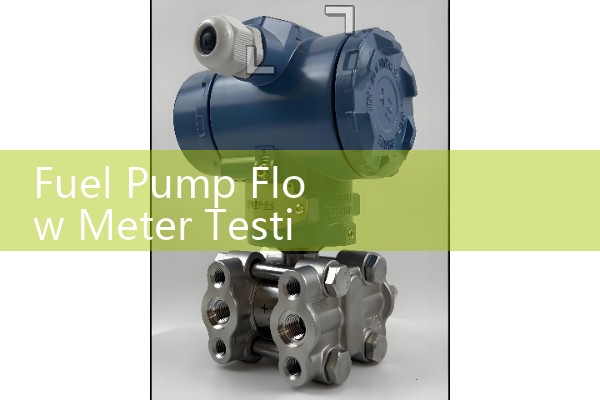
Common ranges are 0 to 5 bar for carburetor pumps, 0 to 10 bar for port injection, and 0 to 25 bar for direct injection feed pumps. Silver Instruments supplies transmitters with 4-20 mA HART output and accuracy of ±0.1 percent full scale.
Connect the flow meter pulse output and the pressure transmitter signal to a paperless recorder or PLC. The recorder plots the pressure curve against volume. This gives you a two-axis map of pump health.
A Real Test Sequence for a 12 V Fuel Pump
Here is a test sequence used by an automotive pump rebuilder in Mexico. Set the tank temperature to 25 degrees Celsius. Run the pump at 13.5 V. Open the back pressure valve fully and record flow for 30 seconds. Then step the valve from 0.5 bar to 5.0 bar in 0.5 bar increments. Hold each step for 20 seconds.
A healthy pump in this example moves 110 L/h at 3 bar and no less than 90 L/h a
Do not start the pass or fail decision from the first pump. Run five to ten reference pumps first. Build a baseline curve. Then test production pumps against that baseline.
Installation Details That Prevent Measurement Error
Air is the biggest source of error on a fuel test bench. Most engineers skip this part and then chase phantom pressure drops. Install an air eliminator upstream of the flow meter. Use a small mesh strainer before the meter on diesel lines. Do not place the meter at the highest point of the line.
For gasoline, keep the meter full of liquid before the pump starts. Vapor bubbles cause spiky readings that look like pressure faults. A downstream back pressure valve keeps enough line pressure to reduce this problem.
Pipe layout matters. Keep a straight run before and after the meter when possible. Oval gear meters do not need long straight runs like turbine meters, but a stable flow path still helps. Use flexible hoses with no sharp bends before the inlet.
Calibration and Documentation
Each Silver Instruments oval gear meter ships with a calibration certificate. The calibration is traceable to ISO/IEC 17025. For test benches that need audit-ready documentation, we can supply matching pressure transmitter certificates.
Recalibrate the fuel flow meter every 12 months or after 2 000 running hours. In practice, a test bench that drifts out of calibration will reject good pumps or pass weak pumps. Keep a master meter on site for quick verification.
Five Questions Engineers Ask Before Buying
Which flow meter type fits a gasoline fuel pump test bench?
An oval gear flow meter is the safest starting point. It handles low flow rates and gives direct volume measurement. It works with gasoline, diesel, ethanol blends, and kerosene.
Can one bench test both low pressure and high pressure fuel pumps?
Yes. Size the flow meter for the lowest expected flow and select a pressure transmitter for the highest expected pressure. You may need two meter ranges if the bench covers very wide output.
What output signals should we use for the flow meter and pressure transmitter?
Use a pulse output from the flow meter for volume totalizing. Use 4-20 mA HART from the pressure transmitter for the pressure curve. Both signals connect directly to a PLC or paperless recorder.
How do you handle temperature changes during a fuel pump test?
Add a PT100 probe and record fluid temperature. Some labs correct volume to 15 degrees Celsius. For diesel, viscosity changes with temperature and affects pump slip. Keep the fuel tank at a fixed temperature for repeatable tests.
Do you supply complete fuel pump test bench instruments or only individual components?
We supply flow meters, pressure transmitters, temperature probes, and paperless recorders as a set. We can also supply only the meter if you already have a PLC and pressure sensors.
Send Silver Instruments your fuel type, pressure range in bar, temperature in Celsius, pipe size in DN, flow range in L/h, and output signal preference. We will reply with a specific meter and transmitter pairing, price, and lead time. Contact Silver Instruments by phone at +86-25-68650347, on Whatsapp at +86-25-52155837, or on WeChat at +86 15365082610.
 Hot Blog
 Related AD