

『Flow Meter for Oxygen Concentrator Operation: Calibrating Low-Flow Medical Gas Rotameters』Related information(clamp on meter|electromagnetic meter|venturi meterrotameter|orifice meter|ultrasonic flow meter|mass flow meter|coriolis mass flow meter|coriolis flow meter|magnetic flow meter|magmeter flow meter|magflow flow meter|mag meter flow meter|electromagnetic flow meter|vortex flow meter|turbine flow meter|thermal mass flow meter|thermal flow meter|rotameter flow meter)
Flow Meter for Oxygen Concentrator Operation: Calibrating Low-Flow Medical Gas Rotameters
Quick Answer
Use a calibrated reference flow meter with accuracy of ±1% of reading or better. Run the oxygen concentrator at a stable inlet pressure, usually 1.5 to 2 bar for service work. Check the rotameter at three points across the range, for example 1 L/min, 3 L/min, and 5 L/min. Adjust or replace the tube if the error exceeds ±5% of full scale.
Why Low-Flow Rotameters Drift in Oxygen Concentrator Service
Most oxygen concentrator rotameters work at 0 to 5 L/min or 0 to 10 L/min. The float is a small ball or bobbin inside a tapered glass or polycarbonate tube. Drift comes from dust, humidity, tube scratches, or a bent needle valve. In practice, a sticky float is the first thing service teams should check before calibration.
We have seen this on customer sites many times. A biomedical workshop in the Philippines found that 12 of 30 rotameters failed calibration because the float was not moving freely. After cleaning with dry nitrogen and replacing the inlet filter, most units returned to ±3% of full scale without any tube replacement.
Equipment Needed for a Field Calibration
You need a certified reference flow meter with a range that covers 0 to 10 L/min and accuracy at least ±1% of reading. A thermal mass flow meter with a 4-20 mA output works well for logging the reference value. You also need a pressure gauge, an oxygen clean regulator, leak check solution, and PTFE tape suitable for oxygen service. Do not use oil based thread sealant.
The reference meter should be placed downstream of the concentrated oxygen outlet. Keep the outlet vented to atmosphere through the reference meter. Inlet pressure to the rotameter must stay constant. A pressure change of only 0.1 bar can shift the reading by roughly 2 to 3 percent. That is enough to fail a medical gas test.
Step by Step Calibration Procedure
First, run the concentrator for 10 minutes and set the flow to 2 L/min on the unit. Connect the reference meter in series with the rotameter outlet. Wait 30 seconds for the float to settle. Read the float at the widest point of the ball, not at the top or bottom. At low flows below 1 L/min, the float can oscillate, so use the average of five readings.
Second, record the values at 0.5, 1, 2, 3, 5, and 8 L/min if the tube covers 0 to 10 L/min. For a 0 to 5 L/min tube, use 0.5, 1, 2, 3, and 5 L/min. Compare each point. The allowed error is usually ±5% of full scale or ±0.1 L/min, whichever is larger for oxygen concentrator service. If a point fails, clean the tube and recheck before replacing the meter.
Third, adjust the needle valve if the error is small and repeatable. If the error is large at low flow only, check for a worn valve seat. Most engineers skip this part. A damaged seat often causes an unstable float at 0.5 L/min even when high flow readings look normal.
Reference Flow Rates and Tolerances
A typical glass tube rotameter for oxygen concentrators has an accuracy of ±4% of full scale and a repeatability of
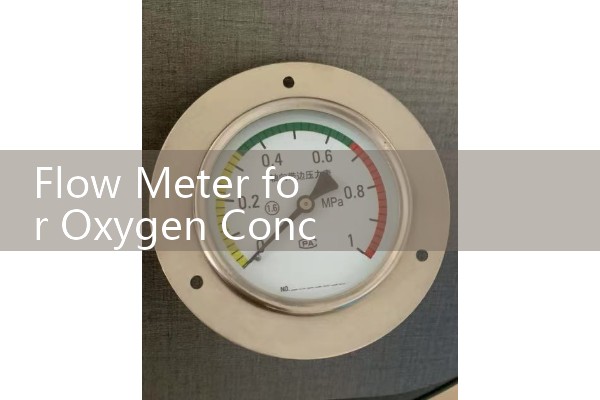
Many service centers calibrate rotameters with air because oxygen is not available on site. If you calibrate an oxygen rotameter with air, the reading usually shifts 3 to 6 percent lower. For a 5 L/min oxygen scale, an air check may read 4.8 to 4.9 L/min at the same actual volumetric flow. Use a correction factor from the tube manufacturer and record it in the calibration sheet. Final pass off should use real oxygen when possible.
Recommended Flow Meter Models for Oxygen Concentrators
Silver Instruments supplies low-flow glass tube rotameters and metal tube rotameters for oxygen concentrator OEMs and service centers. Common ranges are 0 to 1 L/min, 0 to 5 L/min, and 0 to 10 L/min. Standard connections are 1/4 inch NPT, Rc 1/4, or 6 mm compression fittings. For medical builds, we offer oxygen clean brass, stainless steel 316, and PTFE seals.
A customer in Vietnam ordered 200 units of a 0 to 5 L/min rotameter with a polycarbonate shield for portable concentrators. The tolerance requested by their quality team was ±4% full scale. We supplied a batch calibration report with serial numbers. That report saved their incoming inspection team about two days of work per shipment.
FAQ: Five Questions on Low-Flow Oxygen Rotameter Calibration
Q: How often should we calibrate an oxygen concentrator rotameter?
A: Check it every 12 months or after any tube replacement, float replacement, or needle valve repair. For high use units in home care, check every 6 months.
Q: Can we calibrate a low-flow rotameter with air instead of oxygen?
A: Yes for screening only. Use a documented correction factor, usually an offset of 3 to 6 percent for oxygen scales. Final acceptance should use oxygen when possible.
Q: What is the acceptable error for a 0 to 10 L/min rotameter on an oxygen concentrator?
A: Many service programs accept ±5% of full scale, which is ±0.5 L/min. Some OEMs tighten this to ±4% of full scale, which is ±0.4 L/min.
Q: Why does the float bounce at low flow below 1 L/min?
A: Bouncing usually comes from a dirty tube, a worn needle valve seat, or pressure pulsation from the concentrator. Clean the tube first. If bouncing continues, check the valve and consider a damped float version.
Q: What information do you need to quote an oxygen rotameter?
A: Send us your gas type, flow range in L/min, inlet pressure in bar, connection size in DN or inch, tube material, and required accuracy. We will reply with a model and price from Silver Instruments.
Send your flow range, inlet pressure, connection size, and required calibration tolerance to Silver Automation Instruments. Tel: +86-25-68650347. Whatsapp: +86-25-52155837. WeChat: +86 15365082610.
 Hot Blog
 Related AD