

『How Magnetic Flow Meter Works: Faraday’s Law of Electromagnetic Induction Explained』Related information(clamp on meter|electromagnetic meter|venturi meterrotameter|orifice meter|ultrasonic flow meter|mass flow meter|coriolis mass flow meter|coriolis flow meter|magnetic flow meter|magmeter flow meter|magflow flow meter|mag meter flow meter|electromagnetic flow meter|vortex flow meter|turbine flow meter|thermal mass flow meter|thermal flow meter|rotameter flow meter)

How Magnetic Flow Meter Works: Faraday’s Law of Electromagnetic Induction Explained
Quick Answer: A magnetic flow meter uses Faraday’s Law to measure the flow of conductive liquids. It generates a voltage signal directly proportional to fluid velocity, with no moving parts and zero pressure drop. This makes it a reliable choice for water, wastewater, chemicals, and slurries across industries like water treatment, food and beverage, and mining.
Faraday’s Law in Flow Measurement
Michael Faraday showed that a conductor moving through a magnetic field generates a voltage. In a magnetic flow meter, the conductive liquid becomes the moving conductor. Two field coils outside the pipe create a constant magnetic field. As the fluid flows through, charged ions in the liquid move through this field. Electrodes flush-mounted inside the liner pick up the small voltage generated.
The signal voltage follows a simple formula: U = k * B * V * D. U is the induced voltage, B is magnetic field strength, V is average flow velocity, and D is the pipe diameter. The meter electronics convert this voltage into a flow reading in m³/h or liters per minute. Because velocity is proportional to voltage, the measurement is linear and accurate, typically ±0.5% of reading for the standard lineup from Silver Instruments.
The Key Components of a Magmeter
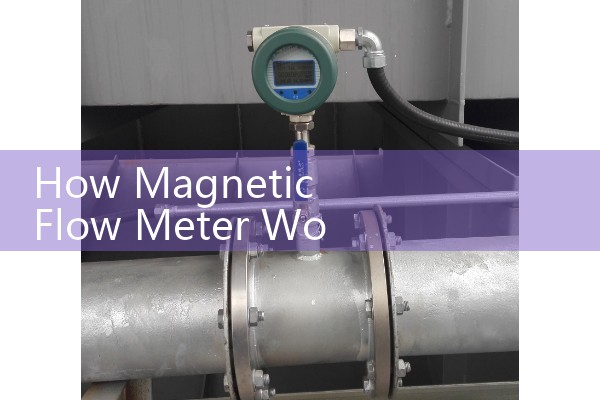
A magnetic flow meter has two main parts: the sensor and the transmitter. The sensor body is a spool piece that installs directly into the process pipe. Inside, a non-conductive liner such as PTFE, PFA, or hard rubber isolates the electrodes from the metal pipe. Liner selection matters more than most engineers think. We have seen a water treatment plant in Vietnam kill a soft rubber liner within six months because they switched to a coagulant with a pH below 3 without telling us.
The electrodes contact the liquid. Standard electrodes come in 316L stainless steel, Hastelloy C, or titanium. For seawater and brine applications, we usually spec titanium electrodes with a PTFE liner. The transmitter converts the microvolt electrode signal to a 4-20 mA HART output, pulse, or digital Modbus RTU. Silver Instruments transmitters include empty pipe detection and built-in self-diagnostics. Most engineers skip this part, but empty pipe detection prevents dry running that can burn out the coils.
Installation Rules That Engineers Often Overlook
In practice, three things determine the performance of a magmeter: grounding, straight pipe runs, and backpressure. The meter must be full of liquid at all times. No partial filling. For horizontal installations, place the electrodes in the 3 and 9 o’clock positions to avoid air bubbles and sediment. The pipe run upstream needs at least 5D of straight pipe (D is pipe diameter) and 2D downstream. For small sizes like DN15 to DN25, you may need 10D upstream, especially if there is a control valve right before the meter.
Grounding or earthing is not optional. Magnetic flow meters need a solid reference to ground. Use grounding rings or a grounding electrode if the pipe is plastic or lined. We supply these as part of the meter package. One customer in Mexico ignored this and had a floating voltage that caused a 20% reading error. After installing grounding rings, the error dropped to below 0.3%.
Because the magnetic field coil draws current during operation, ambient temperature limits apply. Standard remote transmitters of Silver Instruments work up to 60 °C ambient, while integral compact units are rated for 65
Real-World Applications and Limitations
Magnetic flow meters dominate in water and wastewater, especially for raw water intake, sludge, and treated effluent. In the food and beverage industry, they measure milk, juice, beer, and CIP chemicals. A brewery in Indonesia uses five of our DN50 sanitary meters with tri-clamp connections and PFA liners to monitor wort and clean-in-place flows. In chemical plants, magmeters handle acids like sulfuric and hydrochloric, provided you match the liner and electrode materials to the fluid.
Here is the thing: magmeters cannot measure non-conductive fluids. Oils, hydrocarbons, and deionized water with conductivity below 5 µS/cm will not trigger a stable signal. Gas and steam are also out of the question. For these, you need something else, like a Coriolis mass flow meter or an oval gear flow meter.
How to Select the Right Magnetic Flow Meter
Start with pipe size (DN) and flow range. A DN100 meter typically measures 4 to 400 m³/h for water. Next, check the liquid conductivity. Most magmeters need at least 5 µS/cm, but Silver Instruments models can work down to 0.5 µS/cm with a high-impedance amplifier. Then pick the liner material: PTFE for general chemical resistance, PFA for food-grade and vacuum applications, hard rubber for water and slurry up to 80 °C.
For hazardous areas, choose a transmitter with ATEX Zone 1 or IECEx certification. We offer models with Ex d and Ex ia approvals. Process pressure and temperature also matter. Standard flanged meters handle PN16 to PN40; high-pressure versions go up to PN100. Temperature limit depends on the liner, and for temperatures above 180 °C, you need a remote transmitter with a ceramic sensor tube.
FAQ
What is the minimum conductivity required for a magnetic flow meter? Typically 5 µS/cm for most water-based liquids. Silver Instruments transmitters can measure down to 0.5 µS/cm with a high-gain input, which works for condensate and some low-conductivity solutions.
Can magmeters measure non-conductive fluids like oil? No. The fluid must be electrically conductive, at least 0.5 µS/cm. For oil, diesel, or deionized water, consider our oval gear flow meter or Coriolis meter.
How does empty pipe detection work? An additional electrode or impedance measurement detects when the pipe is not full. The transmitter then holds the output signal to zero or alarm, preventing false readings and protecting the coils.
What liner material is best for corrosive chemicals? PTFE offers the widest chemical resistance up to 180 °C. For strong acids at high temperature, PFA is also a good choice. Hard rubber is limited to mild chemicals and temperatures below 80 °C.
Do magnetic flow meters require straight pipe runs? Yes. Typical requirement is 5D upstream and 2D downstream. For smaller diameters or disturbed flow, 10D upstream may be needed. Use flow straighteners if space is limited.
Need a quote for a magnetic flow meter? Send us your flow range (m³/h), pipe size (DN), pressure (bar), temperature (°C), and liquid conductivity (µS/cm). Email [email protected] or call +86-135-1213-1526. WhatsApp: 86-135-12131526, WeChat: +86 13512131526. Visit https://flow-meter.com.au for full specifications.
 Hot Blog
 Related AD