

『Palm Olein Flow Meter Refinery Fractionation Control Setup』Related information(clamp on meter|electromagnetic meter|venturi meterrotameter|orifice meter|ultrasonic flow meter|mass flow meter|coriolis mass flow meter|coriolis flow meter|magnetic flow meter|magmeter flow meter|magflow flow meter|mag meter flow meter|electromagnetic flow meter|vortex flow meter|turbine flow meter|thermal mass flow meter|thermal flow meter|rotameter flow meter)
Palm Olein Flow Meter for Refinery Fractionation Control Setup
Quick Answer
For palm olein fractionation, a Coriolis mass flow meter gives direct mass flow, density, and temperature in one device. This data lets you control cooling rates and crystal formation precisely. We recommend the Silver Instruments CMF series with 316L wetted parts and optional PT100 temperature compensation.
Why Mass Flow Instead of Volume Flow in Palm Olein Fractionation
Palm olein density shifts with temperature. A 3 °C drop from 35 °C to 32 °C changes density enough to throw off a volume meter by 0.5% or more. That error adds up fast when you are trying to control solid fat content. A Coriolis meter measures mass directly. It ignores density swings. You get kilogram per hour readings that stay accurate regardless of process temperature changes. In a typical dry fractionation setup in Indonesia or Malaysia, the cooling phase lasts 4 to 6 hours. Operators need to keep the cooling rate steady at 0.5 °C per hour for the first two hours, then slow it down further. Mass flow data makes that possible.
Picking the Right Flow Meter Type
We see some plants trying magnetic flow meters on palm olein. That does not work. Palm olein has conductivity below 0.1 nS/cm, way too low for a magmeter. Vortex meters can handle the fluid, but they measure volume flow only. You then need a separate density meter and a flow computer. That setup costs more, takes more space, and adds three more potential leak points. Oval gear meters are common in older Malaysian refineries. They drift when viscosity changes. Palm olein viscosity can swing from 40 cP at 35 °C to over 70 cP at 25 °C. The oval gear meter’s bypass leakage changes with viscosity, so you lose accuracy at lower temperatures. A Coriolis meter avoids all these problems.
Silver Instruments CMF Coriolis Meter for Palm Olein
We build the CMF series with full 316L stainless steel wetted parts. No aluminum or brass anywhere near the product contact area. For palm olein lines from DN15 up to DN80, we recommend straight-tube or slightly curved tube designs. A straight-tube design makes CIP cleaning simpler. Our CMF-025 model handles 0 to 3000 kg/h, which covers the feed line of a typical 200 tonnes per day dry fractionation plant. The meter outputs 4-20 mA HART for mass flow, plus a separate 4-20 mA for density. You can also get RS485 Modbus RTU output if your control system is older. We add a built-in PT100 RTD as standard. That gives you a third real time signal: fluid temperature. All three values come from one device with one process connection. No extra thermowells, no extra wiring.
Installation Tips We Have Learned on Site
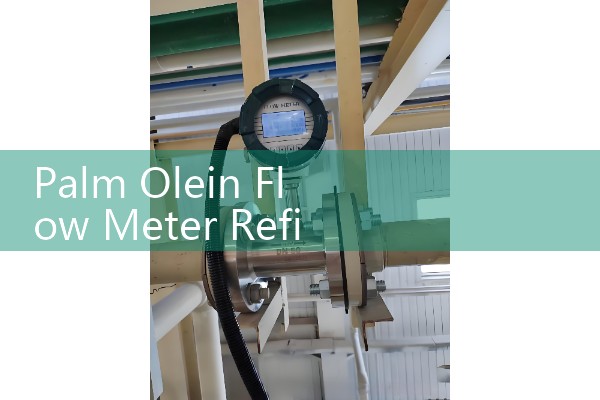
Mount the meter in the feed line after the heat exchanger and before the crystallizer. This spot gives the most stable temperature and avoids two-phase flow. In a palm oil refinery in Johor, Malaysia, we saw a customer install the meter right after a 90° elbow. That gave noisy readings because the flow profile was distorted. We moved it downstream by 10 pipe diameters straight run. The noise disappeared.
Another point: palm olein can contain traces of water from the degumming step. If free water droplets hit the meter tubes, density readings jump. We recommend a simple Y-strainer upstream. It catches occasional water slugs and protects the meter tubes from erosion. A customer in Medan, Indonesia, added a 60 mesh strainer and eliminated false density spikes completely.
If your line is jacketed or traced, make sure the meter body is also heat traced. Keep the meter at process temperature, otherwise palm olein can solidify inside the tubes during a shutdown. A simple electric heating tape
Control Loop Integration with Fractionation PLCs
Most palm olein fractionation plants use a PLC or a small DCS. The mass flow signal from the CMF meter goes straight into the PID loop that controls the cooling water valve. The setpoint is mass flow in kg/h. The operator can input a ramp profile: start at 2000 kg/h, hold for 2 hours, then reduce to 1500 kg/h over the next 3 hours. The density signal tells the PLC how much solid fat has formed. When density drops from 0.910 g/cm³ to 0.905 g/cm³, the batch is close to the target olein fraction. Some customers link the density 4-20 mA signal to an alarm that ends the cooling phase automatically.
We also connect our paperless recorder, the SR-R9600, to log mass flow, density, and temperature over the entire batch. This creates a batch record for traceability. Export the data as CSV and overlay it with lab results. One refinery in East Kalimantan uses this to fine tune their cooling curves every quarter.
Hazardous Area Requirements
Palm oil refineries are not normally zoned as ATEX Zone 1 unless you have solvent extraction nearby. Most fractionation plants fall under Zone 2 or non-hazardous classification. Still, we offer the CMF meter with ATEX II 3G Ex nA IIC T4 certification for Zone 2. The electronics housing is IP67. The cable glands are nickel plated brass. If your plant handles hexane in a separate section, we can supply a Zone 1 version with Ex d IIC T4 housing. Just tell us the gas group and temperature class during inquiry.
Real Numbers from a 300 TPD Plant
A fractionation plant near Dumai, Sumatra, processes 300 tonnes of RBD palm olein per day. They installed three CMF-040 meters on the feed lines to three crystallizer banks. Each meter costs around USD 3,200 ex works. The old oval gear meters needed recalibration every six weeks because viscosity changed. The new Coriolis meters needed no recalibration for 14 months. Product yield went up by 1.8% because the cooling control was tighter. That extra yield paid back the meter cost in less than four months.
Frequently Asked Questions
Why not use an electromagnetic flow meter for palm olein?
Palm olein has extremely low electrical conductivity. A magmeter requires at least 5 µS/cm. Palm olein is typically below 0.1 nS/cm. The meter simply will not register flow.
What pipe size do I need for a 5000 kg/h palm olein feed?
At 40 °C, palm olein density is around 0.910 kg/L. 5000 kg/h equals about 5500 L/h. A DN40 (1½”) line is sufficient. Our CMF-040 handles 0 to 6000 kg/h with a pressure drop below 0.3 bar.
How do I prevent solidification inside the meter during plant shutdown?
Keep the meter body heat traced and insulated. Set the tracing thermostat to 50 °C. Flush the line with hot RBD palm oil before a long shutdown if possible.
Can I use the meter’s density signal to control solid fat content?
Yes. Density correlates with solid fat content in the liquid phase. Most PLC programs can use the 4-20 mA density output to calculate approximate SFC. Consult with your process engineer to build the correlation curve for your specific feedstock.
What information do you need to quote a palm olein flow meter?
Send us your normal and maximum flow rate in kg/h, pipe size (DN), process temperature (°C), operating pressure (bar), and hazardous area classification if any. We will reply with a model number, price, and delivery time within one working day.
 Hot Blog
 Related AD